
Copyright © Aluma Capital (Pty) Ltd. All rights reserved.
Aluma Capital (Pty) Ltd is an authorised Financial Services Provider (FSP 46449) under the Financial Advisory and Intermediary Services Act (37 of 2002)
June 23, 2026

Manufacturing Production – April 2026
In April 2026, South Africa’s manufacturing sector experienced a worrying 2.9% contraction, in stark contrast to earlier growth forecasts. While the Purchasing Managers’ Index (PMI) indicated slight optimism, with a rise to 52.6, the underlying data revealed significant declines in key industries, notably basic iron and steel and motor vehicles, which contributed heavily to the downturn. This article delves into the factors driving this decline, including the impact of US trade tariffs and ongoing diplomatic tensions, which have exacerbated the situation and led to a steep drop in exports. Despite these challenges, manufacturers have taken a cautious yet strategic approach, maintaining robust cash reserves amidst the turmoil. Explore the full report to understand the implications for South Africa’s economic landscape and the future of manufacturing in the region.

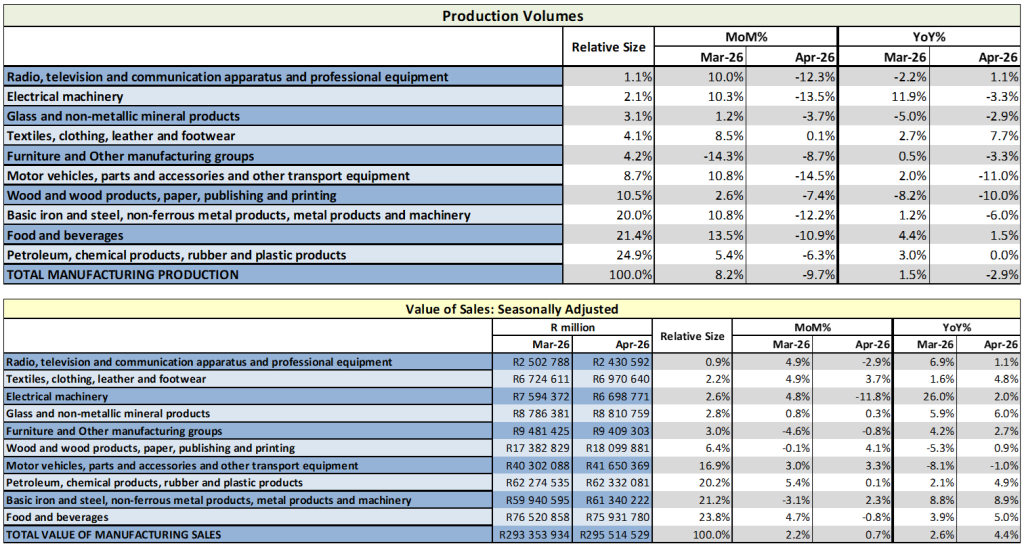
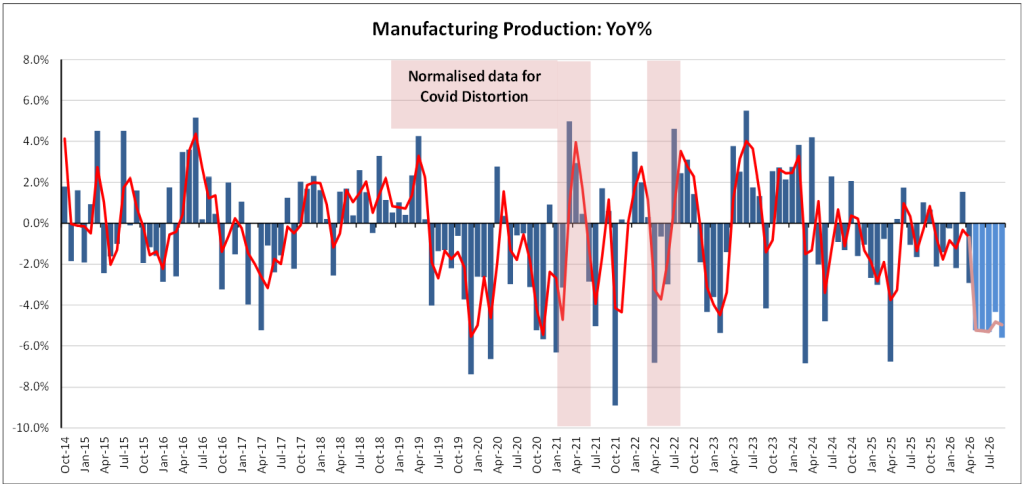
In April 2026, South Africa’s manufacturing output contracted by 2.9%, following the 1.5% increase in March 2026. This decrease is far worse than the 1.2% increase analysts forecast for April 2026. During the same period, the Purchasing Managers’ Index (PMI) increased 3.6 points, from 49.0 in March 2026 to 52.6 in April 2026. This indicates a positive view of the business environment as output expanded within the sector.

The contraction in manufacturing production during April was largely attributed to basic iron and steel, non-ferrous metal products, metal products, and machinery, which decreased by 6.0%, contributing -1.4 percentage points to the overall manufacturing decline. Similarly, the wood and wood products, paper, publishing and printing industry saw a growth decline of 10.0%, subtracting an additional 1.0 percentage points, while the motor vehicles, parts and accessories and other transport equipment industry contracted by 11.0%, subtracting an additional 0.9 percentage points towards manufacturing output during this period. These sectors were significant contributors to the industry’s underperformance in April.

Seasonally adjusted manufacturing production decreased by 1.3% for the rolling quarter ending April 2026 compared to the previous rolling quarter. Out of ten sectors, six reported contractions during this period. Significant contractions included:

  • Petroleum, chemical products, rubber and plastic products, declined by 3.5%, subtracting 0.8 percentage points from growth.
  • Wood and wood products, paper, publishing and printing, which decreased by 3.4%, also contributed a 0.3 percentage point reduction.

Seasonally adjusted manufacturing sales increased by 2.3% during the rolling quarter ending April 2026 compared to the previous rolling quarter. Significant increases occurred in:

  • Basic iron and steel, non-ferrous metal products, metal products and machinery, which increased by 5.7%, adding 1.2 percentage points towards sales growth for the quarter.
  • The motor vehicles, parts and accessories and other transport equipment division, which rose by 7.1%, added another 0.9 percentage points towards sales growth for the quarter under review.

Manufacturing is a critical component of South Africa’s economy, employing approximately 1.58 million people and accounting for 12.5% of the GDP in 2025. Employment slightly increased from 1.548 million in Q4 2025 to 1.587 million in Q1 2026. GDP figures for the fourth quarter indicate a 0.6% quarterly decrease in manufacturing output, suggesting that US trade tariffs since August 2025 have caused some distress in the manufacturing sector by eroding price competitiveness in the US market, driven by higher import prices due to tariffs on South African-produced export goods. It should, however, be noted that exports to the US market have declined by 56% since 2025 due to tariffs, trade tensions and diplomatic “disputes” between Pretoria and Washington.

As a result of trade tariffs with the US and ongoing diplomatic tensions between Pretoria and Washington, business owners remain cautious, as evidenced by the April 2026 PMI data, which is just above the positive 50-point threshold. However, companies are still maintaining substantial cash reserves of approximately R1.8 trillion, up from R1.1 trillion in the first quarter of 2025, according to the Reserve Bank. This reflects a prudent approach amid current domestic and global economic uncertainties in the short- to medium-term.


More Coverage

South Africa’s August 2026 inflation data present a complex outlook: headline CPI rose to 4.4%, remaining below market expectations yet above the upper limit of the inflation target range, while services inflation continued to climb, and fuel and transport costs exerted further pressure on households and businesses. With the economy contracting, international oil prices rising and global uncertainties, including Middle East tensions and tariff disputes, continuing to weigh on the rand and domestic prices, attention is now focused on the South African Reserve Bank’s next interest-rate decision. Read the full report for an analysis of the factors driving inflation, the risks facing the economy and what the latest developments could mean for consumers, businesses and monetary policy in the months ahead.
The recent Electoral Court ruling dismissing the ANC’s bid to compel the IEC to accept late candidate submissions is a significant event with profound implications for the upcoming 4 November 2026 local government elections.
South Africa’s retail sector delivered a striking surprise in July 2026, with sales climbing 3.4% against market expectations of a 3.0% contraction, but the story beneath that headline number is far more nuanced than it first appears. This report unpacks the fragile balancing act facing local households: inflation easing to 4.3% yet still stubbornly above the SARB’s new 2–4% target band, administered prices and utility costs rising by more than 4.0%, wage growth lagging behind severe fuel shocks, and the lingering effect of May’s 25-basis-point rate hike prompted by inflationary pressures well beyond Pretoria’s control. We examine why business confidence firmed (SACCI up from 123.5 to 125.4) while consumer sentiment slumped sharply (FNB/BER down from -7 to -19), which categories, from “other retailers” to general dealers and household goods, actually carried the growth, and what the extension of AGOA to end-2027 means now that fresh visa tensions between Washington and Pretoria have placed South Africa’s eligibility squarely under the microscope. Read the full report to understand whether this recovery has the legs to survive higher fuel prices, a possible second rate increase, and a second-quarter contraction in economic activity — or whether July’s good news was simply borrowed from the easing cycle of 2024/25.
South Africa’s business profitability showed surprising resilience in the second quarter of 2026, outpacing inflation despite a 0.2% contraction in economic activity, higher oil and import prices, trade tariffs, and ongoing diplomatic tensions. While overall profit growth slowed from the first quarter, several sectors, including transport and logistics, mining, electricity and utilities, personal services, and trade, recorded substantial gains, offering important clues about where the economy’s strongest opportunities may lie. This report examines the forces shaping Gross Operating Surplus across key industries, explains the mounting pressures on company performance, and considers whether easing geopolitical tensions, lower oil prices, and greater policy certainty could unlock stronger economic activity, employment, and investment in the months and years ahead.
South Africa’s international liquidity position strengthened in August 2026, with net gold and foreign exchange reserves rising by USD 1,9 billion as the rand gained nearly 30c against the US dollar and the gold price climbed to USD 4 460/oz, some 30% higher than a year earlier. Yet beneath these encouraging headline figures lies a far more complex picture: the ongoing conflict in the Middle East and tensions around the Strait of Hormuz are keeping oil prices elevated, while shifting US tariff measures, a one-year AGOA extension and the Federal Reserve’s decision to hold rates steady all point to continued volatility for the rand. With the South African Reserve Bank’s third-quarter interest rate decisions hanging in the balance, this report unpacks what these commodity and currency movements mean for inflation, the mining sector and South Africa’s economic outlook for the remainder of the year.