Copyright © Aluma Capital (Pty) Ltd. All rights reserved.
Aluma Capital (Pty) Ltd is a registered Financial Services Provider (FSP 46449) in terms of The Financial Advisory and Intermediary Services Act (37 of 2002)
February 13, 2025

Manufacturing Production

December 2024
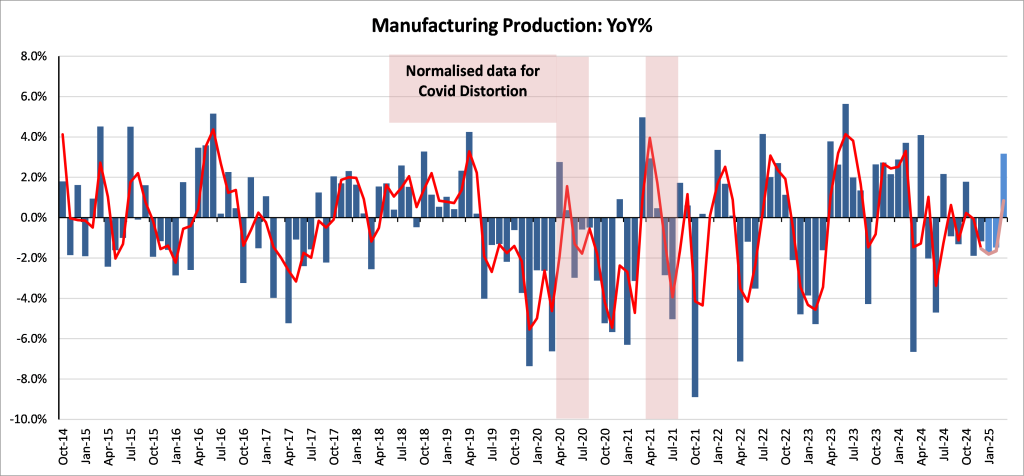
In 2024, South Africa’s manufacturing production declined by 1.2%, driven by lower output in key sectors, including motor vehicles and metal products. However, the food and beverages sector showed strong growth. Despite challenges, the sector remains vital, employing 1.6 million people. Business owners are cautiously optimistic, awaiting clarity on policy and potential investment opportunities.

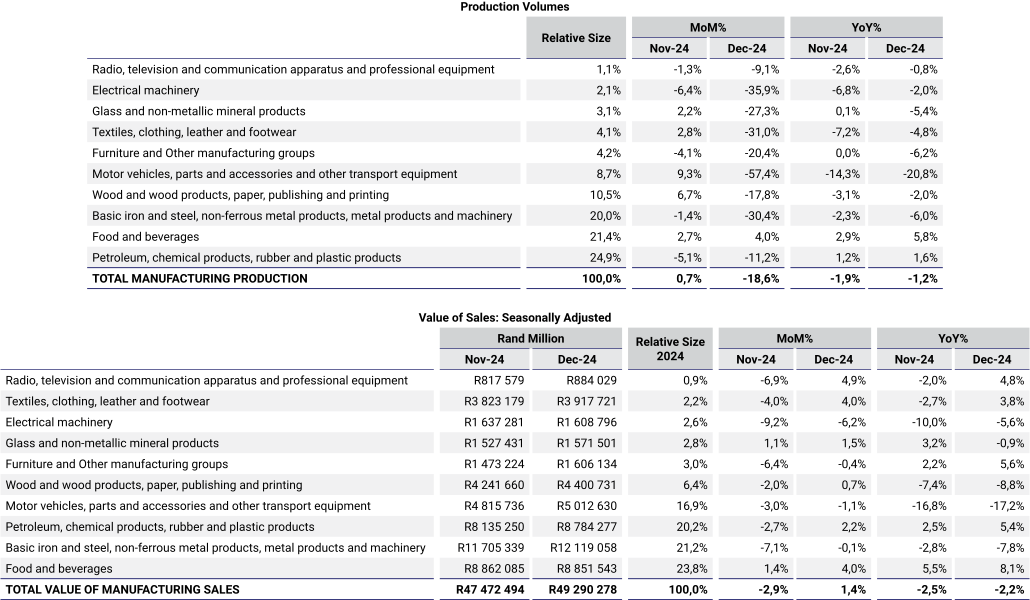
In 2024, manufacturing production in South Africa decreased by 1.2%, following a 1.9% contraction in November. This decline was anticipated, as the Purchasing Managers’ Index (PMI) fell from 48.1 in November to 46.2 in December.

The drop in production volumes can be attributed to several key factors:

  • Basic Iron and Steel, Non-Ferrous Metal Products, Metal Products, and Machinery: Production decreased by 6.0%, contributing -1.2 percentage points to overall manufacturing growth.
  • Motor Vehicles, Parts, and Accessories: This sector experienced a significant decline of 20.8%, adding another -1.2 percentage points.

In contrast, the food and beverages sector saw a robust increase of 5.8%, boosting total output growth by 1.2 percentage points.

The seasonally adjusted value of sales in the manufacturing sector contracted by 0.8% quarter-on-quarter in December. The primary contributors to this decline included:

  • Motor Vehicles, Parts, and Accessories: This sector fell by 2.5%, contributing -0.2 percentage points.
  • Basic Iron and Steel, Non-Ferrous Metal Products, Metal Products, and Machinery: This category decreased by 2.7%, contributing an additional -0.6 percentage points to the quarterly contraction.

As the most industrialized sector on the continent, manufacturing plays a vital role in the South African economy, employing approximately 1.6 million people and contributing about 12.5% to GDP. Despite the importance of this sector for job creation, recent employment statistics reveal a surprising drop in job numbers, from 1.655 million in Q2 to 1.635 million in Q3 of 2024, even with relatively stable PMI figures for the latter half of the year.

Manufacturing business owners are adopting a cautious “wait-and-see” approach towards investment and medium-term growth, especially amid rising diplomatic tensions between Pretoria and Washington, which may lead to potential trade restrictions on South African manufactured goods. Reports from the Reserve Bank and commercial banks indicate that corporate South Africa holds significant cash reserves, suggesting companies are awaiting clarity from the Government of National Unity (GNU) regarding industrial policy, promised reforms, and resolutions to the current standoff with the U.S.


More Coverage

For South African businesses and households already managing a tight financial squeeze, the South African Reserve Bank’s (SARB) recent decision to hike the repo rate to 7.0% felt less like economic medicine and more like a handbrake. While central banks traditionally raise interest rates to cool down an overheating economy, South Africa’s current reality is vastly different. Our recent inflation spike isn’t driven by a wild shopping spree, but by global supply shocks and an imported energy crisis. This begs the crucial question: is the SARB using the wrong tool for the job, and at what cost to our fragile economic growth?
The case for holding interest rates is strong, as South Africa’s current inflation is being driven by global supply-side pressures like fuel prices, not excessive local spending. Raising rates now would place additional strain on already struggling consumers and businesses without addressing the real cause of inflation. With the Rand strengthening, oil prices stabilising, and diesel costs expected to decline, natural inflation relief is already emerging. Since inflation remains within the SARB’s target range, increasing borrowing costs could unnecessarily slow economic growth and job creation.
Amid a turbulent economic backdrop, South Africa’s retail sales surged by an unexpected 2.6% in March 2026, outpacing forecasts and signalling a fragile yet persistent recovery in the consumer market. While interest rate cuts have bolstered household spending, challenges such as rising inflation, potential interest rate hikes, and geopolitical tensions loom large. Despite these hurdles, sectors like “other retailers” and general dealers have notably contributed to this growth spurt, raising questions about the sustainability of this recovery. With business and consumer confidence indices displaying mixed signals, the future of South Africa’s retail strength hinges on international relations, fuel costs, and policy decisions. Explore the dynamics and implications of these developments in our detailed report.
In an insightful analysis of South Africa’s economic landscape in April 2026, the report delves into the notable 4.0% year-on-year increase in the Consumer Price Index, accentuated by surging costs in housing, utilities, transport, and financial services. Amid rising inflationary pressures fuelled by global uncertainties, including the Middle East conflict and climbing oil prices, the South African Reserve Bank faces critical decisions on interest rates to balance inflation and economic growth. As households grapple with diminished purchasing power, the precarity of reliance on short-term credit looms large, while international factors such as US-imposed tariffs and potential BRICS trade tensions threaten market stability. The report provides a comprehensive look at the delicate dance South Africa must perform to maintain price stability and safeguard the Rand amidst a challenging global backdrop.
Next week’s SARB decision could define South Africa’s economic trajectory: facing an external oil shock and runaway electricity tariffs that threaten to push April inflation past the central bank’s 4.0% ceiling, policymakers must weigh a technical inflation breach against a staggering surge in unemployment and collapsing investment, a choice between credibility and survival. With joblessness spiking and GDP growth stagnant, aggressive rate hikes would risk choking off the private investment the country urgently needs, while inaction could dent the new inflation-targeting framework. Read the full report for a detailed breakdown of the shocks driving this dilemma, the likely “hold” outcome from the May 28 MPC meeting, and what it means for businesses, households, and markets.